
Cladding boards are planed timber boards with profiled edges used to clad the facade, interior walls and ceilings of a building. For facades and interiors, LatvijasKoks.lv offers spruce and pine cladding boards, which cost 15 EUR/m² in the catalogue. They are 20-25 mm thick, 75-250 mm wide and 1-6 m long. For sauna rooms, the catalogue has separate black alder, aspen and linden cladding boards at 18-22 EUR/m².
Updated 24 November 2026.
Cladding board prices and sizes in the catalogue
The table sums up the cladding boards in the LatvijasKoks.lv catalogue and the planed timber that can be used, for example, for cladding battens.
| Product | Use | Sizes | Price |
|---|---|---|---|
| Spruce or pine cladding boards | facade, interior walls, ceilings | 20-25 x 75-250 mm, length 1-6 m | 15 EUR/m² |
| Black alder cladding boards | sauna room | on request | 18 EUR/m² |
| Aspen cladding boards | sauna room | 18-30 x 75-200 mm, length 1-6 m | 20 EUR/m² |
| Linden cladding boards | sauna room | 18-30 x 75-200 mm, length 1-6 m | 22 EUR/m² |
| Planed pine or spruce boards and beams | construction and finishing | 2-20 x 5-30 cm, length 1-6 m | 400 EUR/m³ |
Prices are shown excluding VAT.
The catalogue states that the boards can be cut to the required length and painted in a chosen colour by separate agreement. The boards can also be delivered and bought together with screws or nails.
Cladding board profiles
The profile is the cross-section shape of a board, especially the shape of its edges. The profile determines how the boards join each other and how the clad wall looks. The LatvijasKoks.lv catalogue lists several standard profiles.
- Tongue and groove boards. The tongue is a lengthwise ridge on one edge of a board that fits into the groove on the edge of the next board.
- Shiplap boards. A step (rebate) is milled into the board edges, and neighbouring boards partly overlap each other.
- Bench boards with rounded edges. They are used for sauna benches.
- Milled beams. These are machine-profiled beams used for the walls of garden houses.
On order, LatvijasKoks.lv can also make another profile with a specially prepared cutter knife.
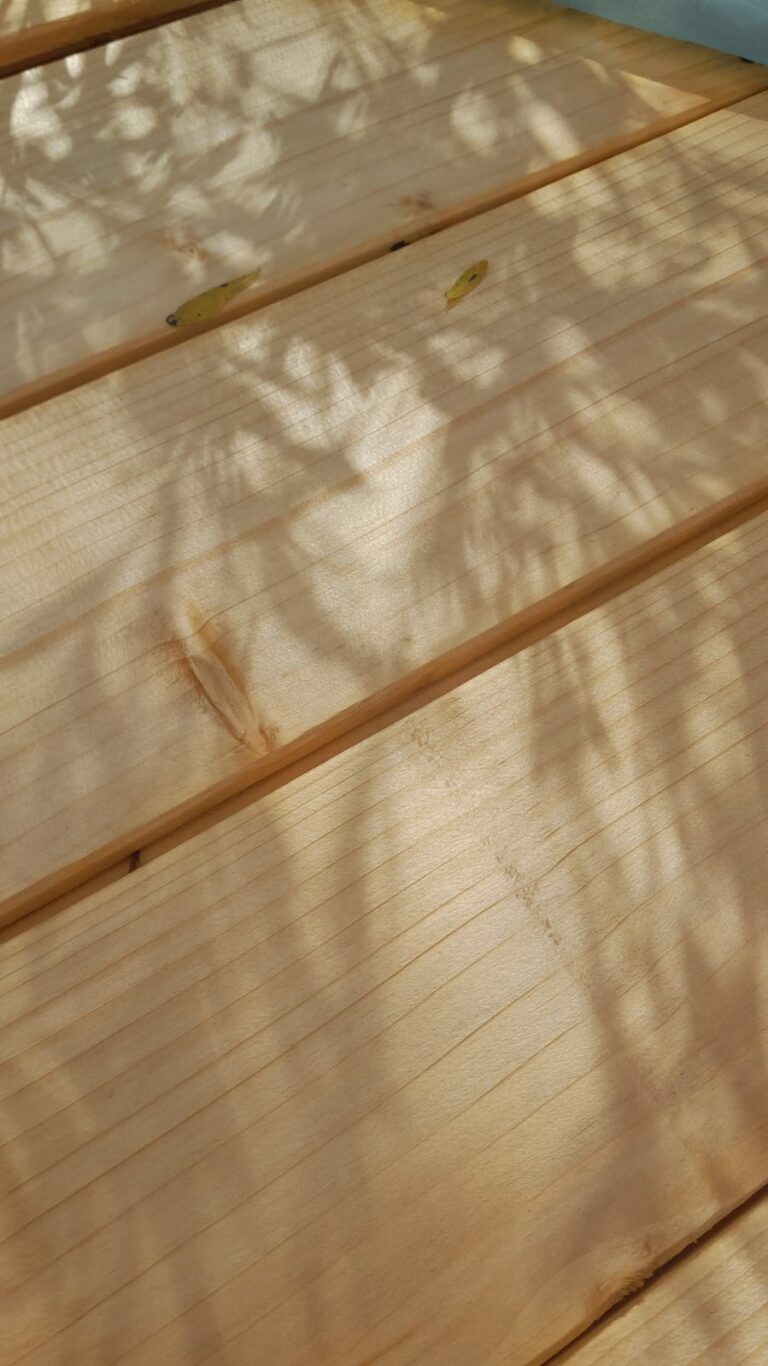
TräGuiden, the handbook of the Swedish wood industry organisation Svenskt Trä, states that vertically fixed tongue and groove boards form a fairly rain-tight facade cladding. Such cladding is ventilated by vertical ventilation battens placed behind the horizontal fixing battens.
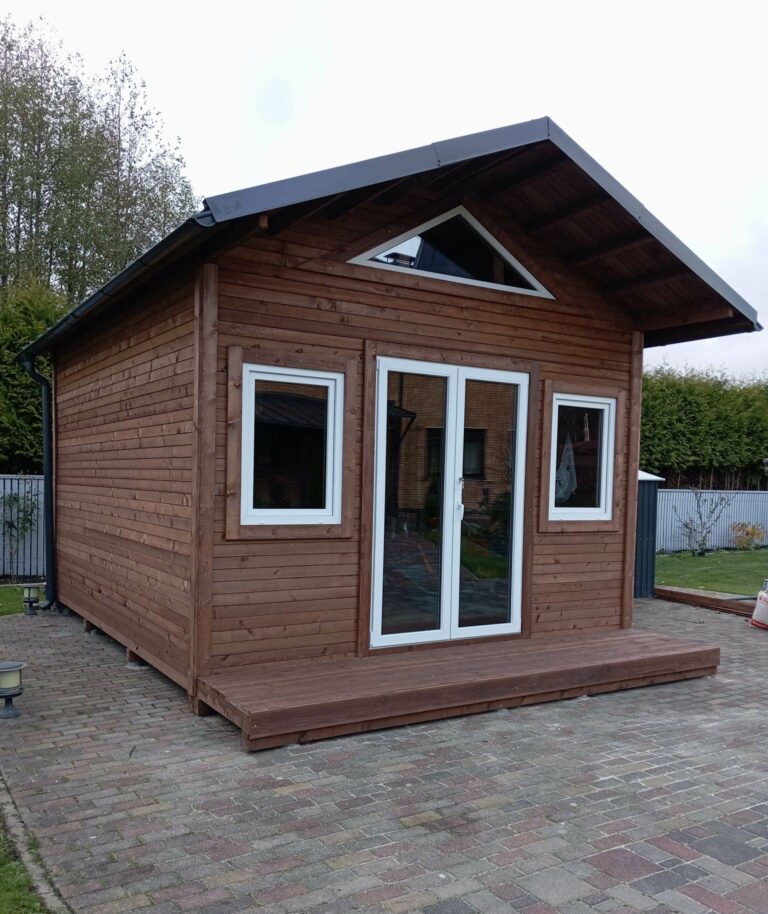
The 4 x 6 m garden house offered in the catalogue is made of 45 mm thick milled beams. It costs 6400 EUR, and delivery is not included in the price.
Spruce or pine
The LatvijasKoks.lv catalogue recommends spruce or pine for exterior cladding. The wood species descriptions of the German Timber Trade Federation (GD Holz) mention both species for facade cladding as well as for interior wall and ceiling cladding.
| Property | Spruce | Pine |
|---|---|---|
| Colour | yellowish white, turns yellowish brown in light | sapwood white and yellows in light, heartwood yellowish to reddish brown and darkens strongly in light |
| Density | 430-470 kg/m³ | 510-550 kg/m³ |
| Drying | little cracking and warping | drying too fast can cause fine cracks |
| Resin | fresh wood has a faint resin smell | wood sometimes very resinous |
| Natural durability | class 4 | class 3-4 |
The density in the table is given for air-dry wood with 12-15 % moisture content (the amount of water in the wood). Sapwood is the outer, lighter part of the trunk, and heartwood is the inner part. In spruce, sapwood and heartwood cannot be told apart by colour.
The EN 350 standard rates the natural durability of wood against wood-destroying fungi in five classes. Class 1 means very durable wood and class 5 non-durable wood. Spruce is placed in class 4, meaning slightly durable wood, and pine in class 3-4, meaning moderately to slightly durable wood. TräGuiden names the construction details that need attention for a durable facade. They are described in the next section.
The GD Holz descriptions state that once the resin spots have been cleaned, both spruce and pine take any finish well. Either opaque paint or a stain (a transparent coating through which the wood grain shows) can be used.
Basic principles of facade cladding
TräGuiden describes several basic principles of facade cladding that apply to both vertical and horizontal cladding.
- An air gap is left between the cladding and the water-repellent wind barrier. The wall then works on a two-stage principle, because water that gets through the cladding is stopped by the wind barrier and does not reach the wall structure.
- The cladding ends at least 200 mm above the ground.
- Upward-facing board ends are covered. Downward-facing ends are shaped so that they can be painted and maintained.
- The boards must be neither too wide nor too thin, otherwise they can swell, shrink, warp and crack.
- The face and edges of the boards are primed at the factory or on site before fixing.
- Fixings are placed at least 100-150 mm from the board end. If the distance is less than 150 mm, pre-drilling the holes is recommended so that the board end does not split.
Vertical cladding is sensitive to moisture damage, because many board ends face downwards and catch rain splashing up from the ground. Special water drainage is needed at the plinth (the lower part of the building wall) and above windows, for example with metal flashings.
Interior wall and ceiling cladding
Indoors, cladding boards are used for walls and ceilings. The GD Holz descriptions mention spruce and pine for interior wall and ceiling cladding, and spruce also for sauna building. For a sauna room, LatvijasKoks.lv recommends black alder, linden or aspen. These species are compared in the article on sauna boards of black alder, linden or aspen.
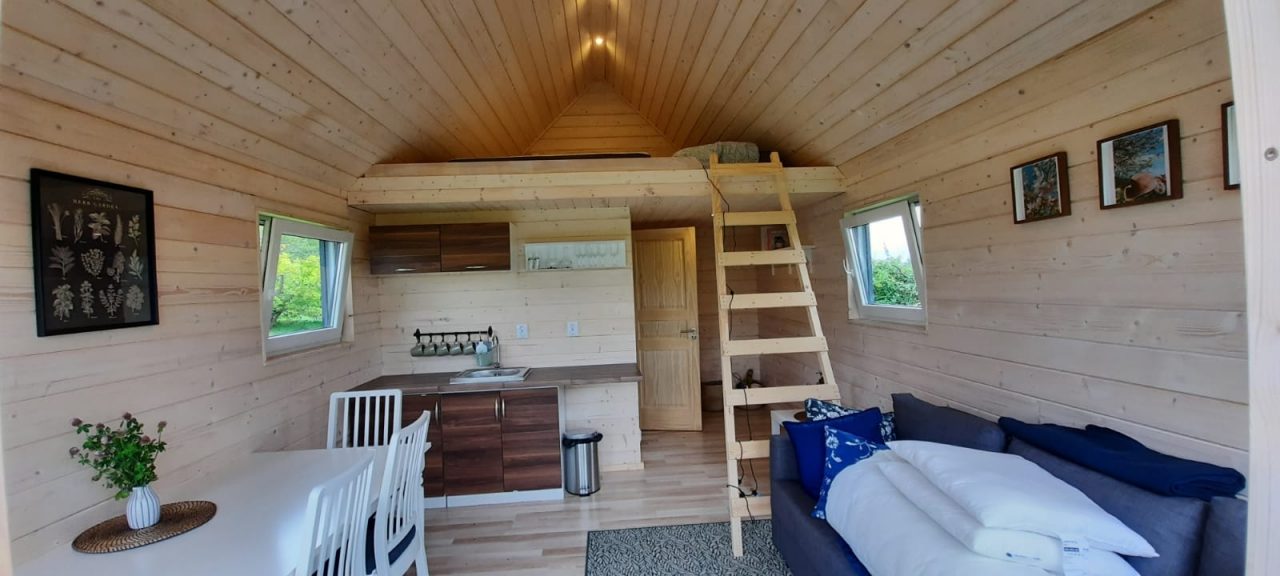
LatvijasKoks.lv also makes modular houses.
How many cladding boards are needed and what they cost
The amount of cladding is calculated in square metres. The wall area is the building perimeter multiplied by the wall height. The area of windows and doors can be subtracted, while for a building with a gable roof the triangular parts of the gable walls under the roof are added.
In the table, the wall area is calculated for buildings with 2.5 m high walls, without subtracting windows and doors and without adding the gable triangles. The price is based on the catalogue price of spruce or pine cladding boards, 15 EUR/m².
| Building size | Perimeter | Wall area | Board price |
|---|---|---|---|
| 3 x 3 m | 12 m | 30 m² | 450 EUR |
| 4 x 6 m | 20 m | 50 m² | 750 EUR |
| 6 x 8 m | 28 m | 70 m² | 1050 EUR |
If the boards are tongue and groove or overlap, each board covers a narrower strip than its full width. That is why the exact amount depends on the board profile and width, and it is calculated in the quotation.
Planed pine or spruce timber, which costs 400 EUR/m³ in the catalogue, can be used for the cladding battens.
Does changing the cladding need building authority approval
In Latvia, the Building Regulations (Ēku būvnoteikumi, Cabinet of Ministers Regulation No. 529) set out when building intention documents are needed. These are documents submitted to the local building authority before construction work starts. The following points may apply to cladding and finishing work.
- An interior design project that does not include renovation, reconstruction, restoration or demolition work does not require building intention documents (point 7.1.).
- Painting a facade in its existing colour shade does not require building intention documents (point 7.2.).
- Renovating a group one building (a simple, small building) without changing its volume, type of use or architectural appearance requires no documents. This does not apply to cultural monuments (point 7.3.1.).
- Renovating or reconstructing a group two residential building with one or two flats, without changing its volume or type of use, requires a construction notification. This does not apply to cultural monuments (point 7.¹ 6.).
If the new cladding changes the appearance of the building, for example the colour or the direction of the boards, the building authority decides which documents are needed in each case.
Frequently asked questions
Which boards are suitable for a facade?
For exterior cladding, LatvijasKoks.lv recommends spruce or pine cladding boards. The GD Holz wood species descriptions mention both species for facade cladding. Spruce is lighter, while pine heartwood is yellowish to reddish brown and darkens in light.
How much do cladding boards cost?
In the LatvijasKoks.lv catalogue, spruce or pine cladding boards cost 15 EUR/m². Black alder sauna cladding boards cost 18 EUR/m², aspen 20 EUR/m² and linden 22 EUR/m².
How many cladding boards does a house facade need?
The wall area is the building perimeter multiplied by the wall height. For a 4 x 6 m building with 2.5 m high walls that is 50 m², without subtracting windows and doors and without adding the gable triangles. The exact amount depends on the board profile and width.
Do facade boards need priming before fixing?
TräGuiden recommends priming the face and edges of the boards at the factory or on site before fixing. LatvijasKoks.lv can paint the boards in the required colour by separate agreement.
How high above the ground should the facade cladding end?
TräGuiden recommends ending the cladding at least 200 mm above the ground. That way, less rain splashing up from the ground reaches the board ends.
Can cladding boards be cut to length and delivered?
Yes. The catalogue states that cladding boards can be cut to the required length, painted, delivered and bought together with screws or nails.
How to order
A quotation needs the wall dimensions or the area to be clad, the preferred wood species and profile, the board thickness and width, the colour if the boards are to be painted, and the delivery address.
Call +371 29 828 152, message us on WhatsApp or email info@latvijaskoks.lv.
Related pages
- Cladding boards and sauna bench boards
- Sauna boards of black alder, linden or aspen
- Garden houses and saunas
- Modular houses
- Contact
Sources
- LatvijasKoks.lv, cladding boards (prices per m² and m³, sizes, profiles, recommended species for exterior cladding and saunas, cutting, painting and delivery), latvijaskoks.lv/apdaresdeli/, viewed on 24 November 2026.
- LatvijasKoks.lv, garden houses and saunas (4 x 6 m garden house of 45 mm thick milled beams), latvijaskoks.lv/pirtinu-katalogs/, viewed on 24 November 2026.
- Gesamtverband Deutscher Holzhandel (GD Holz), Merkblattreihe Holzarten, sheet 057 "Fichte" (July 2015), gdholz.net, viewed on 24 November 2026.
- Gesamtverband Deutscher Holzhandel (GD Holz), Merkblattreihe Holzarten, sheet 062 "Europäische Kiefer" (July 2015), gdholz.net, viewed on 24 November 2026.
- Svenskt Trä, TräGuiden, "Stående utvändig panel" (updated 1 April 2020), traguiden.se, viewed on 24 November 2026.
- Cabinet of Ministers of Latvia Regulation No. 529 of 2 September 2014 "Ēku būvnoteikumi", points 7.1., 7.2., 7.3.1. and 7.¹ 6., version in force from 1 October 2026, likumi.lv/ta/id/269164, viewed on 24 November 2026.